Soft Tissue Modelling: Breast application and theoretical developments
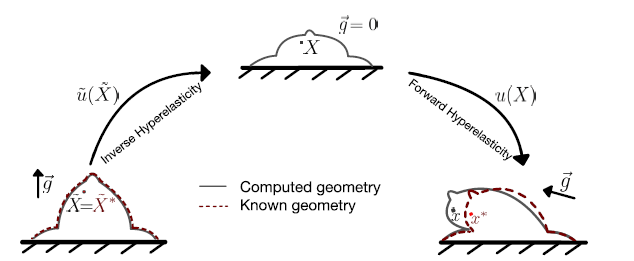
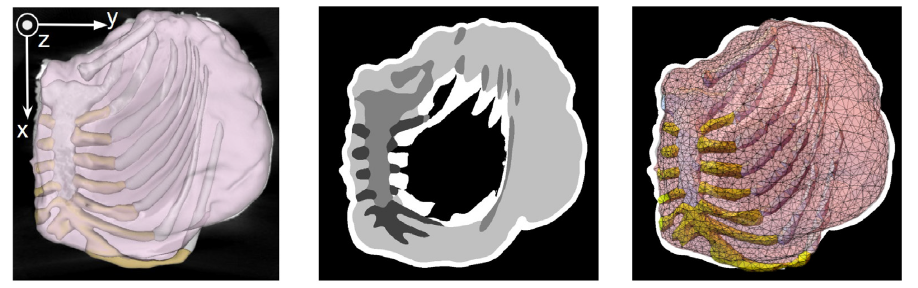
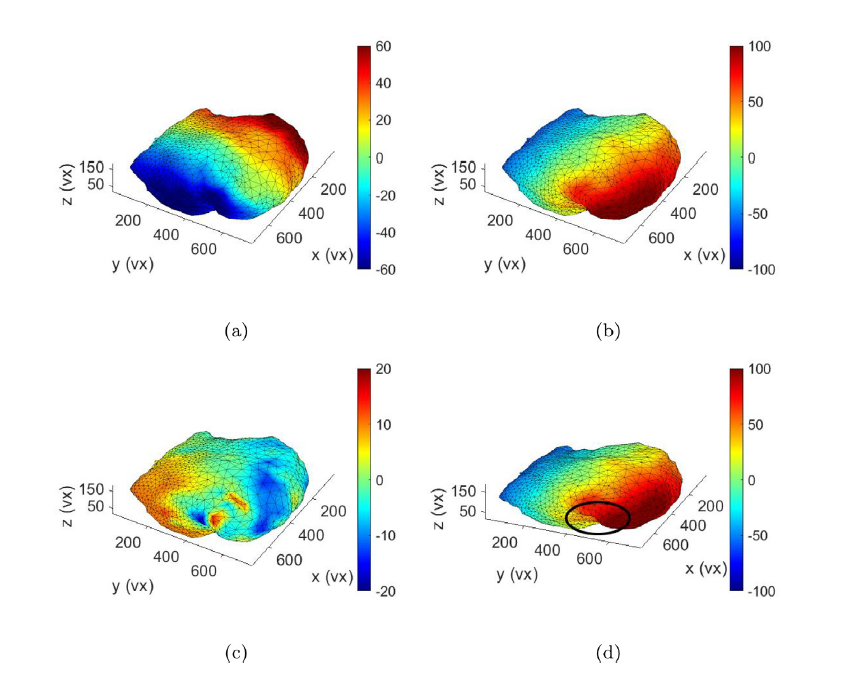
This area of research is dedicated to the advanced biomechanical characterization of soft tissues and bodies, particularly under complex conditions involving large deformation and contact. The project is built on two inter-connected technical pillars. First, we developed and evaluated a Digital Volume Correlation (DVC) pipeline to accurately measure 3D kinematic fields within soft tissues under significant displacements. This innovative methodology, which utilizes X-ray tomography for detailed imaging, has critical clinical applications, such as enabling the precise mapping of ex vivo breast deformations to improve the accuracy of radiotherapy planning by assisting with tumor repositioning. Complementary to this, the project also designed a novel optimization framework that employs an inverse+forward hyper-elasticity formulation to simultaneously identify the unknown material parameters and the contact traction field of soft bodies from measured deformed geometries. By rigorously integrating computational modeling with experimental data, this work provides powerful tools for a complete and robust understanding of soft tissue mechanics in various physiological and loading scenarios. (Lavigne et al. 2023),(Lavigne et al. 2022)
❮ ❯